
One critical aspect of every cleanroom is its air handling system, which can be designed to provide a single pass of air through the space or recirculate it. Prior to making a selection for your cleanroom design, it’s important to understand both systems, what makes them unique, and the advantages and disadvantages of each. This way, you can make an informed decision about an airflow design that addresses the specific needs of your contaminant-free environment.
The Importance of Airflow Systems in Cleanrooms
In order to ensure a cleanroom remains contaminant-free, the system’s airflow is incredibly important. The goal of an airflow system is to eliminate particulate matter (PM) from the cleanroom, whether it be dust, fumes, or bacteria. Consistent airflow keeps a space compliant with industry standards and allows the work done in a cleanroom to be completed smoothly.
Single Pass Cleanrooms
Single pass air flow systems can also be known as once-thru or one pass cleanrooms. This system continuously brings ambient air into the cleanroom through surrounding space, which is then filtered through HEPA filters that remove 99.9% of contaminant particles 0.3 microns in size and larger. This is typically accomplished with Motorized Fan Filter Units, which then exhaust the air through low-wall returns back into the ambient space.
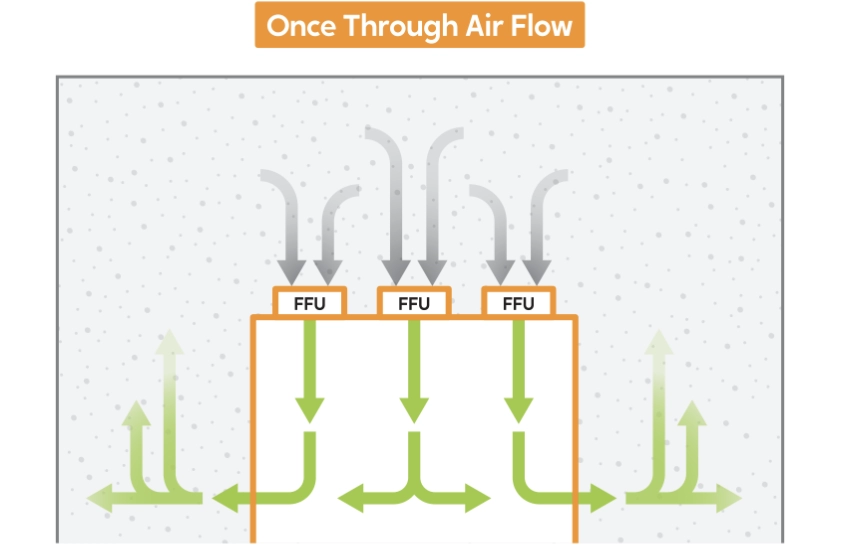
Advantages of Single Pass Cleanrooms
The primary advantages of once-thru cleanrooms are the simplicity of design and lower cost. Compared to recirculating systems, single pass cleanrooms are easier to configure and install without the necessary presence of central air. This way, the systems can also take up less space and are a more portable option for a contaminant-free environment. Since these factors contribute to the price of the system, single pass cleanrooms are more affordable than recirculating.
Disadvantages of Single Pass Cleanrooms
The lack of a central air system presents single pass cleanrooms with a few disadvantages. The internal temperature and humidity of a cleanroom is dependent on the surrounding ambient air, so a hot and humid environment will make for a hot and humid cleanroom. This can create discomfort for personnel who are already in cleanroom garments, especially since it is difficult to independently control the temperature of the cleanroom from the surrounding environment.
Recirculating Cleanrooms
A recirculating air flow system, also referred to as closed-loop air flow, is a design that continuously recirculates air within a cleanroom. Similar to once-thru cleanrooms, air is filtered through HEPA filters that remove 99.9% of particles 0.3 microns in size and larger with Motorized Fan Filter Units. However, rather than releasing the air back into ambient space, it is returned to the HEPA filters through a return air chase. This is often accomplished by having a plenum above the cleanroom ceiling.
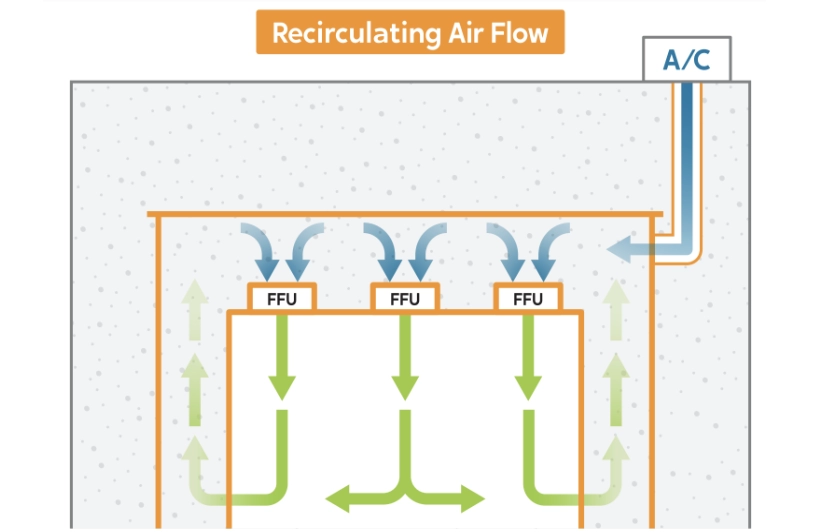
Advantages of Recirculating Cleanrooms
Recirculating cleanrooms allow for tight control over temperature and humidity, which is a notable advantage over once-thru cleanrooms. Especially important for cleanrooms with a lower ISO Class, recirculating systems are highly capable of controlling cross contamination. Because clean air is continuously being filtered through the room, these systems typically have lower contaminant particle counts. HEPA fan filter units also last longer in recirculating cleanrooms, since they are filtering air that is already clean.
Disadvantages of Recirculating Cleanrooms
While more regulated in regards to temperature and contamination, recirculating cleanrooms require a complex design and higher cost. These systems typically take up more space and may not be as modular in configuration, so they are a less flexible contaminant-free solution. Plus, the price is not always accessible for businesses on a budget.
Which Cleanroom Airflow System is Right for You?
Whether you choose a single pass or recirculating cleanroom airflow system is ultimately driven by the level of your need for temperature and humidity control. Once-thru cleanrooms can achieve any ISO Class and are especially effective if your surrounding ambient air temperature is adequately controlled to meet process/creature comfort needs. Conversely, if you are controlling temperature and/or humidity independently from the surrounding ambient space, recirculating cleanrooms are the better choice. These systems offer complete control and better prevent cross-contamination to ensure your room is as clean as possible.
For additional support with selecting the cleanroom airflow system that’s right for you, contact us. At Flow Cleanrooms & Supply, we’re happy to answer your questions and walk through the airflow options available for your contaminant-free solution.