USP <797>, created by the United States Pharmacopeia (USP), establishes the manufacturing standards and processes for sterile pharmaceutical compounding. It outlines critical requirements for facility design, environmental controls, personnel training, and quality assurance to minimize the risk of contamination and ensure patient safety.
Designing a USP <797> Compliant Cleanroom
As these standards call for highly regulated and controlled environments, it is critical to ensure that your cleanroom is properly set up. Overviews of key requirements from USP <797> are highlighted below.
Required Room Layouts
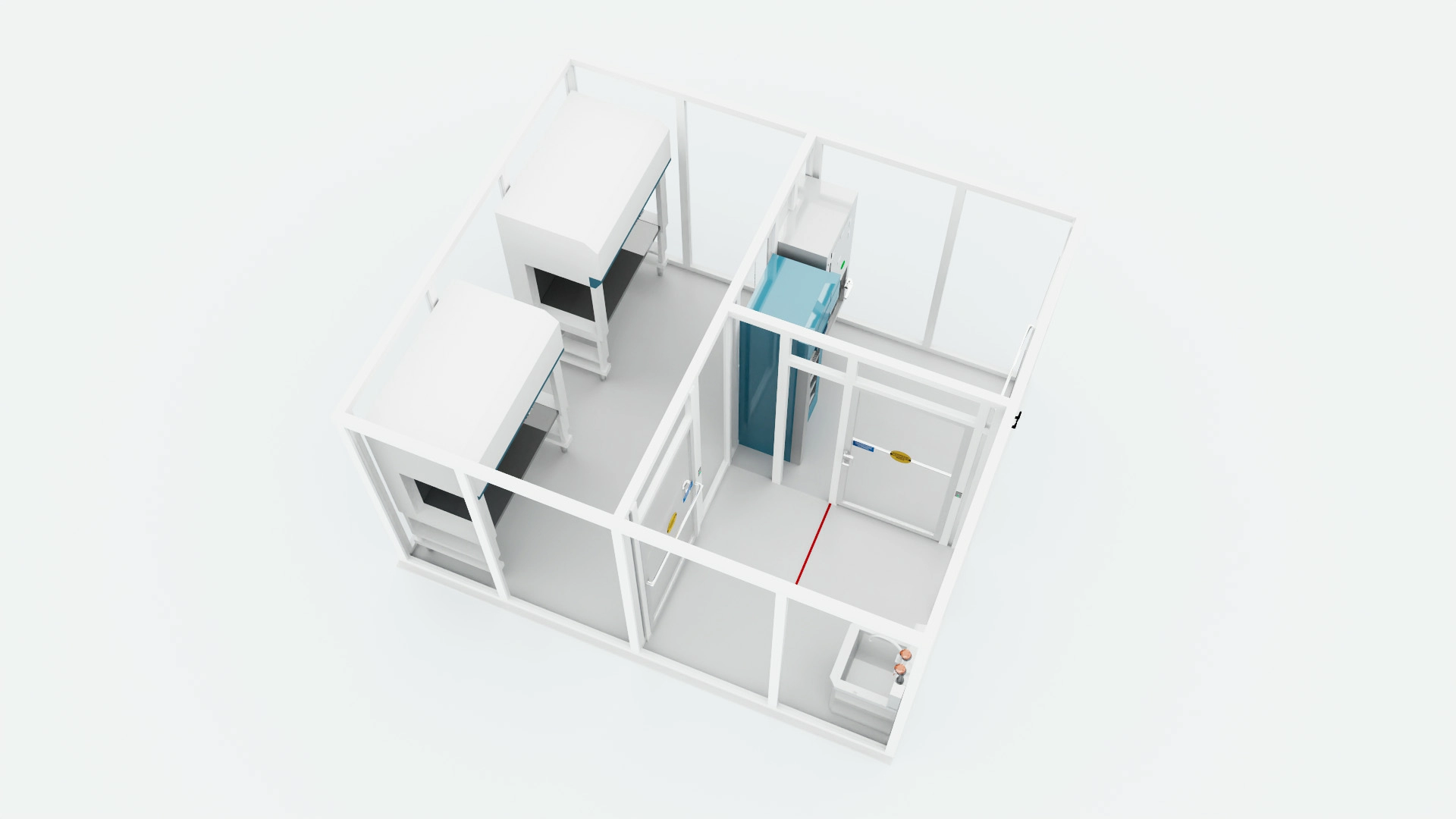
An example of a USP <797> cleanroom layout is depicted in the image above. Before mapping out the placement of different stations within the facility, the first step is to plan where each required room will be located. Here are the cleanroom zones that USP <797> requires:
- Ante Room (ISO class 8 or higher)
- Functions as a transition space for employees to properly don cleanroom garments and wash their hands to prevent outside contaminants from coming into the buffer room.
- Must have positive pressure relative to the surrounding outside area.
- Buffer Room (ISO class 7)
- Acts as the primary sterile compounding area.
- Air quality must be at least ISO class 7.
- Must have positive pressure relative to the ante room.
- Primary Engineering Control (PEC) Area (ISO class 5)
- Typically a biological safety cabinet (BSC), the PEC exists as the critical zone for sterile compounding.
- The PEC area is located within the buffer room.
- Air quality must be able to maintain ISO class 5 conditions.
- Airflow must be unidirectional.
- PEC must have positive pressure relative to the buffer room.
USP <797> Risk Levels
With the USP’s update to <797> in 2023, the risk levels have changed to provide better clarity. Risk categories rank 1 through 3 where the higher the number, the stricter the environmental controls and monitoring frequency. It also uses Beyond-Use Dating (BUD) as a guide for determining the risk level.
- Category 1
- Only used in Segregated Compounding Areas (SCA) – a controlled environment for facilities that do not have the bandwidth for a cleanroom suite.
- Beyond-Use Dating:
- Room temperature: less than or equal to 12 hours
- Refrigerated: Less than or equal to 24 hours
- Requires basic cleanroom garments and monthly air sampling.
- Category 2
- Found in ISO class 7 buffer room with an ISO class 5 PEC.
- Beyond-Use Dating:
- Room temperature: up to 4 days
- Refrigerated: up to 10 days
- Frozen: up to 45 days
- Must have a full cleanroom suite and enhanced environmental controls.
- Requires weekly air sampling.
- Category 3
- Found in ISO class 5 PEC in an ISO class 7 buffer room with an ISO class 8 ante room.
- Beyond-Use Dating:
- Up to 180 days with regular sterility testing.
- Requires strict personnel training and compliance with proper gowning requirements.
- Requires weekly air and cleanroom surface sampling and sterility testing.
Air Pressure Differentials & Airflow Direction
As detailed above, each section of a USP <797> cleanroom must have positive air pressure compared to its adjacent space. Positive air pressure in cleanrooms is maintained by HEPA-filtered air being pushed into the room through supply vents. This pressurized air can only exit through designated exhaust points, preventing outside contaminants from entering and compromising the sterility of the compounding environment.
Additionally, the airflow in the cleanroom must move in a direction that sweeps contaminants away from critical areas. Typically, a smoke test is conducted to observe the airflow’s path and test whether it is unidirectional.
Environmental Controls
USP <797> mandates specific environmental controls to better maintain sterile conditions in cleanrooms. Here is an overview:
- Use HEPA filters to maintain air pressure differentials for designated ISO classification.
- Regulate humidity within the cleanroom to below 60% relative humidity.
- This helps prevent static and bacterial growth.
- Maintain a room temperature at 68°F or cooler.
- Restrict access to the cleanroom to authorized persons only.
- Implement proper gowning procedures and hygiene (e.g. washing hands) for employees and ensure that they are being followed.
USP <797> Certification
While USP does not issue certifications directly, there are third-party organizations that offer accreditation to qualifying facilities. For instance, the NABP Compounding Pharmacy Accreditation has a recognized and reputable USP <797> certification program for those who wish to demonstrate their expertise.
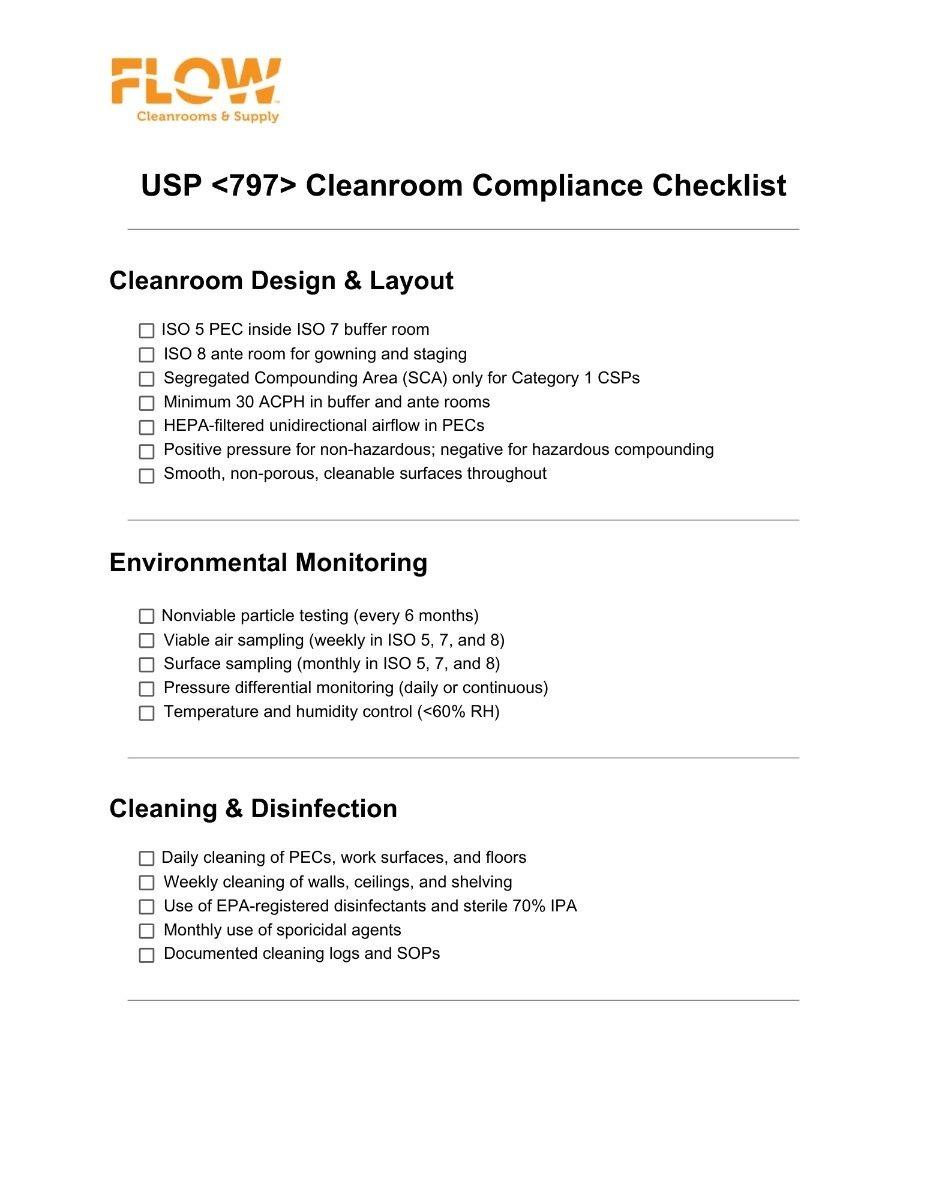
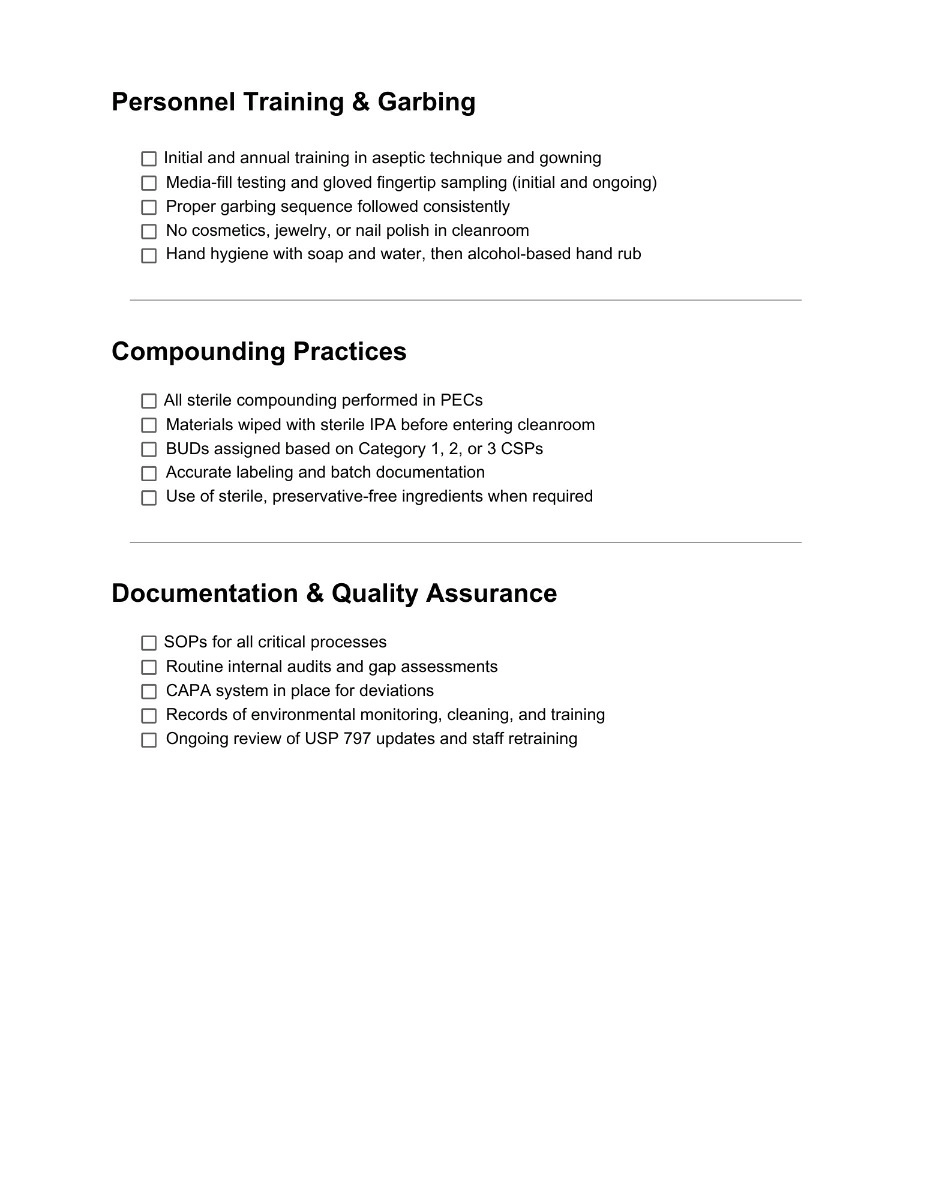
USP <797> Cleanroom Compliance Checklist
To help make sure that your cleanroom meets requirements, below is a checklist for your reference.
Contact Us for Help Designing a USP <797> Compliant Cleanroom
Ensuring compliance at every step is tough. If you have any questions on setting up your cleanroom, contact the team at Flow Cleanrooms. We’re here to help.

