
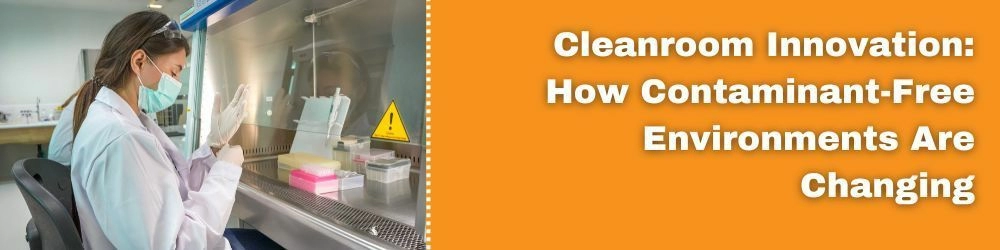
With the introduction and implementation of Industry 4.0, manufacturing worldwide has radically shifted, and cleanrooms are no exception to this change. Let’s explore just how far the cleanroom industry has come.
Cleanrooms of the Past
Historically, cleanrooms have served critical roles in industries where precision and sterility are essential—such as pharmaceuticals, microelectronics, aerospace, and biotechnology. The earliest “cleanrooms” emerged in the early 20th century with the manipulation of ventilation in healthcare treatment centers, a process that was bolstered following innovations in air filtration that emerged during the Second World War.
Early cleanroom models were relatively basic in design, often using rudimentary filtration systems and relying heavily on manual processes to maintain standards. These environments typically adhered to early federal or military standards, such as FED-STD-209E, which categorized cleanrooms based on particle counts per cubic foot of air.
Initially, cleanroom classifications were primarily designed for manufacturing simplicity rather than flexibility. The focus was primarily on physical barriers and HEPA filtration. Unlike today’s cleanroom operations, monitoring was largely manual, with minimal real-time feedback or automation. Despite their limitations, these early cleanrooms paved the way for today’s more sophisticated, adaptive environments.
The Current State of Cleanrooms
Modern cleanrooms have undergone significant transformation, driven by stricter regulatory demands, technological advances, and more complex manufacturing needs. ISO 14644-1 (ISO Class 1 through ISO Class 9) has replaced older standards like FED-STD-209E, introducing a more comprehensive and globally recognized cleanroom classification system.
Today, cleanrooms rely on a complex synthesis of design, engineering, and personnel. Controlled environments integrate advanced airflow management systems, seamless (often modular) panels, doors, and passthroughs, automated monitoring for airborne particles and environmental conditions, and sophisticated gowning protocols. Industries like semiconductor fabrication and advanced pharmaceuticals now rely on Class 100 or ISO Class 5 environments, where even a single contaminant particle can compromise product integrity.
Sustainability and operational efficiency have also become priorities. Energy-efficient HVAC systems, LED lighting, and real-time environmental controls are now commonplace, reducing both operational costs and environmental footprints.
Emerging Trends in Cleanrooms Today
As regulatory frameworks and technological capabilities evolve, so do the trends shaping the future of cleanroom environments. Increasingly, cleanroom design must balance sterility with flexibility, scalability, and efficiency. Below are some of the most impactful trends currently shaping the cleanroom landscape:
Modular Cleanroom Construction
One of the most transformative trends is the adoption of modular cleanroom systems. Unlike traditional stick-built cleanrooms, modular systems offer rapid deployment, flexible design changes, and scalability. Depending on application requirements, modular cleanrooms incorporate soft-, rigid-, or hardwall panels, as well as doors, pass-throughs, and filtration systems that can be reconfigured without major downtime or capital construction costs.
This approach also facilitates easier integration of new technologies and makes cleanroom upgrades less disruptive. Modular construction is particularly appealing for contract manufacturing organizations (CMOs) and startups that need agility in scaling production environments quickly.
Smart Cleanrooms
The rise of Industry 4.0 has reached the cleanroom sector in the form of “smart” cleanrooms. These environments use sensors, automated monitoring systems, and Internet of Things (IoT) connectivity to track environmental variables like temperature, differential pressure, humidity, and particulate matter in real-time.
Automated data logging, virtual controls, and monitoring ensure regulatory compliance while predictive maintenance tools reduce downtime. Smart cleanrooms can proactively identify risks and initiate alerts before human operators would even be aware of a deviation. The result: improved product integrity, operational efficiency, and compliance reliability.
Emphasis on Sustainable Design in Cleanrooms
There is a growing emphasis on sustainability and energy-efficient systems, recyclable materials, and waste reduction—particularly in pharmaceutical and semiconductor manufacturing, where resource consumption is high.
Due to their prefabricated design, ease of installation and reconfiguration, and air-tight, energy efficiency, modular cleanrooms have become a staple in sustainable manufacturing. These cleanrooms can be equipped with closed-loop HVAC systems, as well as adaptive lighting to meet sustainability practices and certifications’ specifications.
Quick and Flexible Deployment of Cleanrooms
Highly technical industries are innovating faster than ever. To stay competitive, companies increasingly need additional controlled environment space for research, development, and manufacturing—often on accelerated timelines.
Modern cleanroom solutions, particularly modular systems and turnkey, prefabricated, leasable modules, can be deployed in just days or weeks. These flexible options minimize downtime and significantly speed up time to market.
Innovate Your Cleanroom with Flow Cleanrooms
Flow Cleanrooms has been at the forefront of modular cleanroom innovation for decades, and we’re ready to take your operations to the next level. Connect with our experts today by filling out our quick contact form.
