
To protect both worker safety and a product’s integrity, all facilities handling hazardous drugs must comply with USP Chapter <800>. This guide will elaborate on all of the essential design elements of a USP <800> compliant cleanroom, so you can safely and efficiently prepare your operational facility.
Designing a USP <800> Compliant Cleanroom
As USP <800> relates to the production of hazardous drugs, it is imperative to adhere to the USP’s guidelines at every step. We’ve outlined the key takeaways from the requirements below:
Required Room Layouts
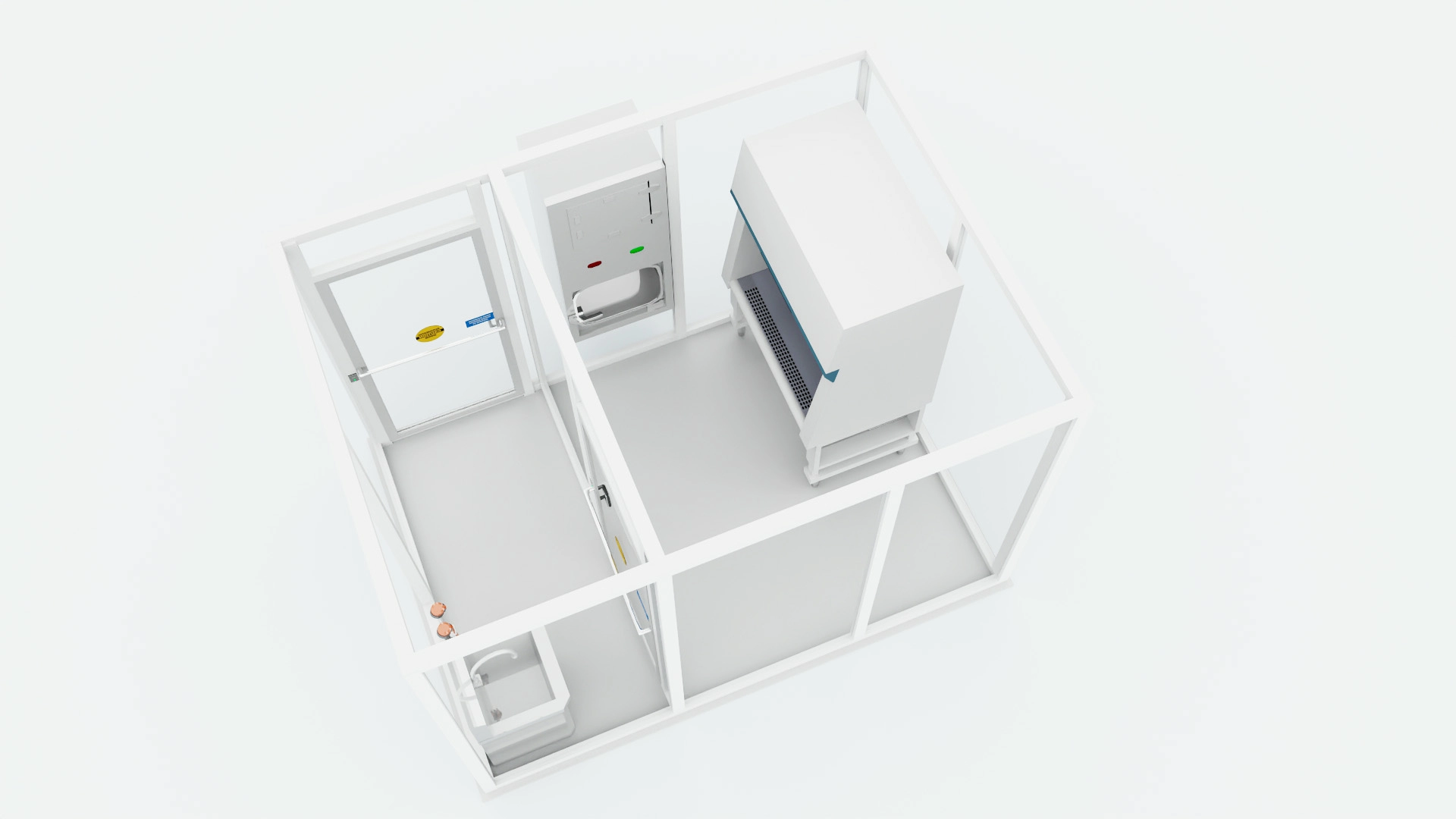
The first fundamental step in designing a USP <800> compliant cleanroom is mapping out the layout of the required rooms. Here are the required cleanroom zones as mandated by USP <800>:
- Hazardous Drug (HD) Buffer Room (ISO Class 7)
- Functions as the home for the Primary Engineering Control (PEC).
- Must have negative air pressure relative to its adjacent areas AND an external exhaust ventilation system with HEPA filtration.
- Ante Room(ISO Class 7)
- Functions as the transition space between the buffer room and pharmacy. This is the space where employees should gown cleanroom apparel and wash hands.
- Note: the handwash sink should be located outside of the ante room, NOT inside of the hazardous drug room.
- Must maintain positive air pressure relative to the hazardous drug buffer room.
- Functions as the transition space between the buffer room and pharmacy. This is the space where employees should gown cleanroom apparel and wash hands.
- Hazardous Drug (HD) Storage Area
- As the name implies, this area functions as a storage space for hazardous drugs.
- This area must be separated from the non-hazardous drug storage.
- Requires external ventilation and the ability to maintain negative air pressure. There must be at least 12 air changes per hour (ACPH).
USP <800> Risk Levels
As USP <800> centers on hazardous drugs, it relies on The National Institute for Occupational Safety and Health (NIOSH) list to determine its risk categories; however, it is important to note that the NIOSH categories are not USP-defined risk levels.
- Antineoplastics
- These drugs are considered the highest risk level and are primarily used in cancer treatment.
- Requires full compliance with USP <800>.
- Non-Antineoplastics
- These drugs meet hazardous criteria, but they are not typically used for cancer treatment.
- Reproductive Hazards
- These drugs may pose risks to fertility or fetal development.
Modular cleanrooms can be fully compliant with USP <800> if designed and constructed to meet the chapter’s rigorous standards. This includes ensuring ISO Class 7 environments, directional airflow, external exhaust ventilation, and pressure differentials. Properly specified modular solutions offer speed of deployment, flexibility, and validated performance for hazardous drug compounding.
Air Pressure Differentials & Airflow Direction
As mentioned above, each section of a USP <800> compliant cleanroom follows different air pressure differentials. To recap, the hazardous drug buffer room and the hazardous drug storage room must have negative air pressure relative to its adjacent rooms, while the ante room must have positive air pressure relative to its adjacent rooms.
In general, air within USP <800> cleanrooms must flow away from the clean areas. Following this directional flow of air helps prevent hazardous particles from migrating to undesired places, thus reducing the risk of contamination. As previously mentioned, HEPA filtration is required for incoming air and air must be exhausted externally and safely.
Environmental Controls
As per USP <800>, hazardous drugs must be prepared in a Containment Primary Engineering Control (C-PEC) to better control hazardous particles in the air. This equipment must be placed in a room called a Containment Secondary Engineering Control (C-SEC), which has negative air pressure (between −0.01 and −0.03 inches of water column relative to adjacent spaces) and at least 12 air changes per hour to keep the air fresh and safe. If you're doing short-term sterile compounding (Category 1), you can use a simpler space called a Segregated Compounding Area, but it still needs proper airflow and pressure controls.
All surfaces must be regularly cleaned using steps that deactivate, remove, and disinfect any drug residue. While USP <800> doesn’t set exact temperature or humidity levels, facilities must monitor air pressure, airflow, and cleaning routines to stay compliant and safe.
USP <800> Certification
The USP does not issue certifications directly, however, there are third-party organizations that offer accreditation to qualifying facilities. The NABP Compounding Pharmacy Accreditation has a recognized and reputable USP <800> certification program for those who wish to showcase expertise to potential and current clients.
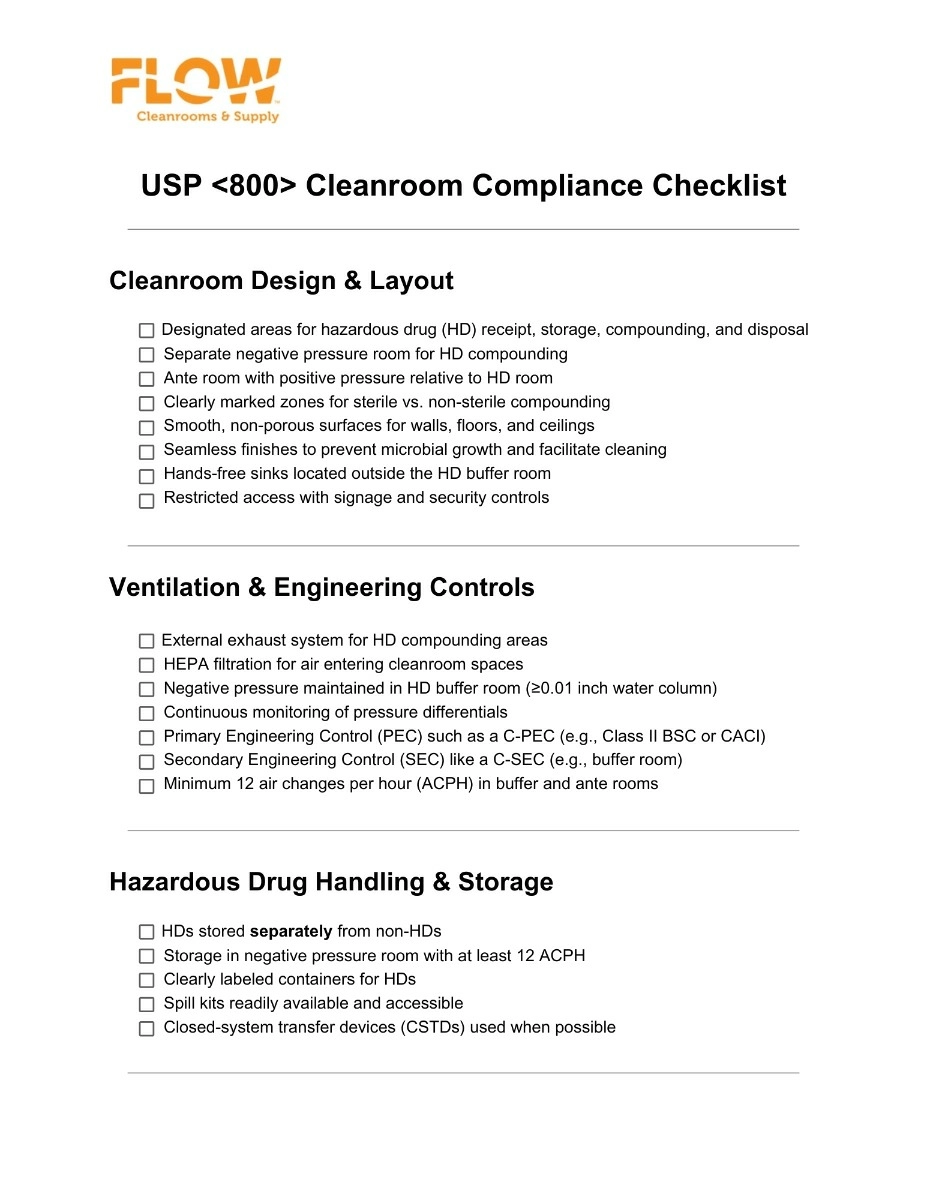
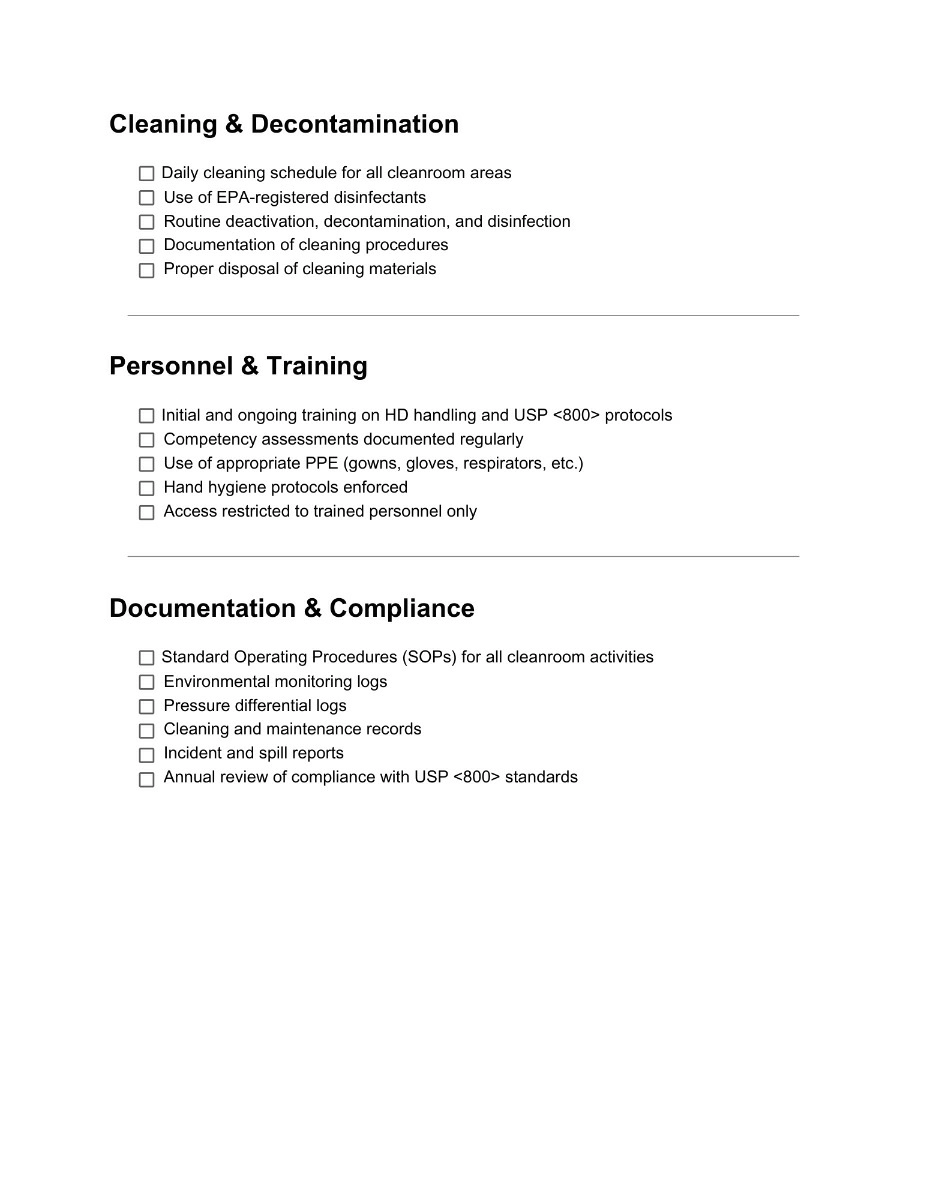
USP <800> Cleanroom Compliance Checklist
To help ensure that your cleanroom meets USP <800> requirements, below is a comprehensive checklist for your reference.
Contact Us for Help Designing a USP <800> Compliant Cleanroom
For manufacturers developing products in highly controlled environments, ensuring compliance at every stage can be complicated. The team at Flow Cleanrooms is committed to assisting you in every way possible. Reach out with any cleanroom-related questions today.
