
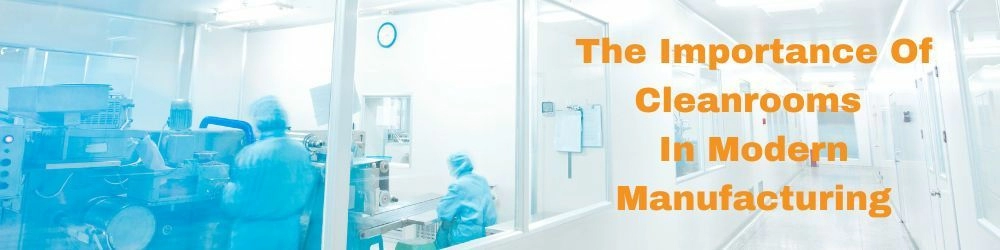
In manufacturing, production for its wide range of industries – from pharmaceuticals to electronics – often requires strict regulations. Cleanrooms play a very important role in these types of manufacturing environments, as they help to keep processes contaminant-free. If you’re exploring cleanroom solutions for your own manufacturing space, it’s important to understand how cleanrooms are used in these industries, why they are important, and how to determine which cleanroom is the best fit for your needs.
How are Cleanrooms Used in the Manufacturing Industry?
The primary objective of a cleanroom is to limit the amount of airborne particles in a given space and keep it as clean as possible. For manufacturing industries with strict regulations, cleanrooms are used to ensure products meet specific standards before going to market. This is done through air filtration systems, which can be either single-pass or recirculating. Your choice of air filters typically depends on how clean your space needs to be and also fits into the ideal type of modular cleanroom for your production process.
Additional steps taken to reduce the risk of contamination in a manufacturing cleanroom include gowning and cleaning procedures. People who enter a cleanroom must wear specific garments to stay “clean,” such as gloves, coveralls, face masks, and bouffant caps. Unique chemicals and cleaning supplies are used to keep away contaminants, and particle counters can measure the amount of foreign particles in a room. All of these actions help preserve the integrity of both the room and your manufacturing production process.
What Type of Cleanroom is Best for Your Manufacturing Needs?
The type of cleanroom you choose ultimately depends on what you are trying to control in your manufacturing environment, as well as air pressure, relative humidity, and temperature. Cleanrooms are categorized based on their ISO Classification, which ranges from ISO 1 to 9 and is determined by the amount and size of particles allowed in a space per cubic meter of air. The lower the ISO number, the “cleaner” the room is. These factors can help determine whether a softwall, rigidwall, or hardwall cleanroom is the best choice for you. While all three types offer room particle control, your ability to adjust humidity, temperature, and air pressure is slightly lower with softwall and rigidwall cleanrooms. These options are more easily reconfigured and can be quickly installed, and are ideal if a low ISO class is not your top concern. In cases where production must be completely controlled, and there is no need for your set-up to be portable, a hardwall cleanroom is likely the best way to go.
While your choice in cleanroom type is not always industry-specific, there are a few different areas of manufacturing that tend to lean towards either softwall or rigidwall cleanrooms. Due to the affordability and modular capabilities of softwall cleanrooms, these are often the preferred choice for start-up companies, as well as aerospace, research and development (R&D), medical, and pharmaceutical industries. Conversely, bioburden and medical device industries often choose rigidwall cleanrooms, because they require more regulated environments.
Why are Cleanrooms Important to Modern Manufacturing?
While cleanrooms are not essential for every manufacturing industry, they are highly valuable for products that do need to be strictly regulated. When cleanrooms are not involved in a manufacturing company’s production, there is a higher likelihood of items being made with defects or quality issues. These concerns can prevent items from going to market, as well as limit efficiency and success in the production process. The strict environment of a cleanroom helps to ensure products meet specific standards of regulation and can be safely sold to consumers. In order to streamline production and create products that have an overall higher quality, cleanrooms are crucial to manufacturing.
Contact Flow for Your Manufacturing Cleanroom
Ready to take the next step and choose a modular cleanroom for your manufacturing needs? At Flow Cleanrooms, our team is prepared to offer the support needed for you to make a decision you’re confident in. Contact us to get your questions answered and receive intentional guidance throughout the entire cleanroom process – from planning to delivery.
